


Your first portfolio does not need to be large. It needs to be convincing. Twelve photographs that agree with each other will do more for you than eighty that drift in different directions, and getting to that twelve is mostly a series of small decisions: this one, not that one.
The encouraging part is that culling and editing are skills rather than talents. They improve with practice, and they follow a process you can borrow today. Here is a practical route from a full memory card to a set you are happy to put your name on.
Shoot With Room to Choose
Culling is far easier when you gave yourself options. That does not mean holding down the shutter and hoping. Four hundred frames of one subject simply creates thirty near-identical pictures you will struggle to separate a month later. Aim instead for a handful of deliberate variations: move your feet, switch from wide to close, wait for a second gesture. Then stop.
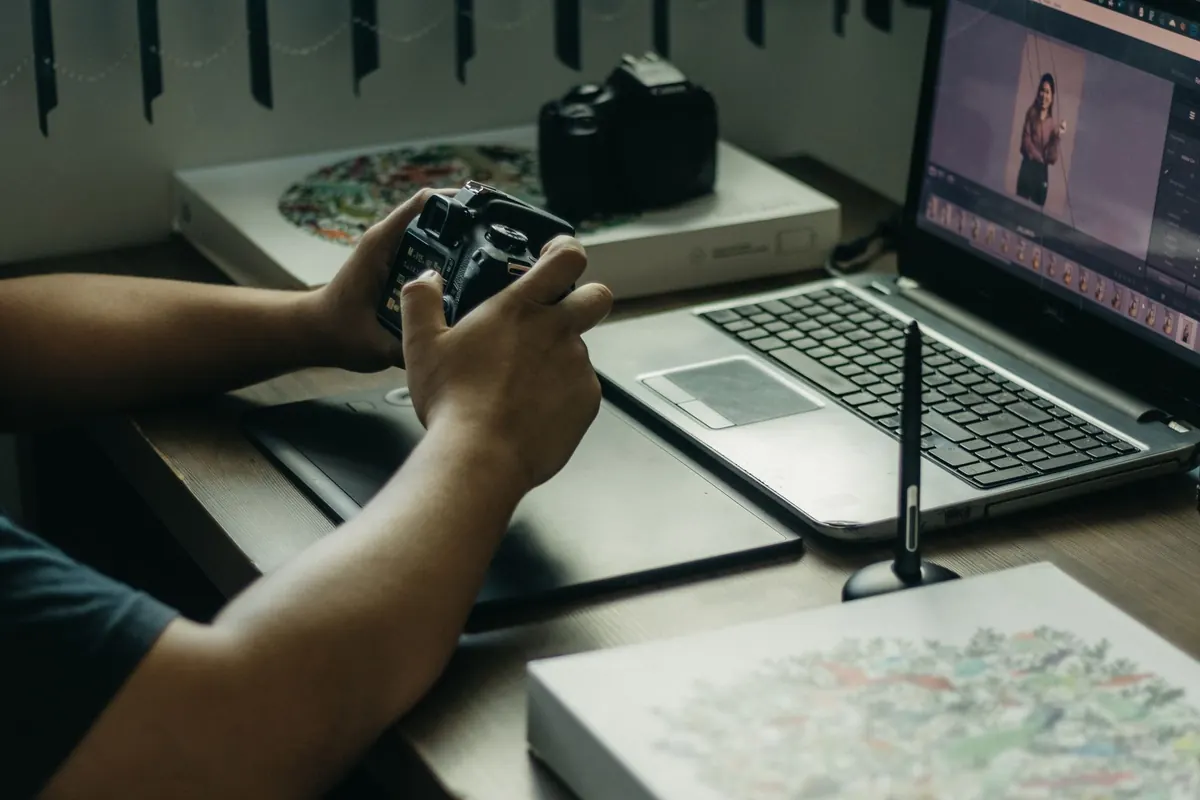
It also helps to check as you go. Zoom in on the back of the camera after a promising frame. If the focus is off, you find out now rather than on the evening you sit down to build your portfolio.
The First Pass: Clear the Wrecks
Set your viewer to show six or eight images at once and move quickly. You are not judging quality yet, only removing what cannot possibly work.
- Missed focus and unintended motion blur
- Blinking, mid-word expressions, half-turns
- Blown highlights or crushed shadows you did not mean
- Lens-cap shots, test frames, accidental duplicates
Flag these as rejects rather than deleting them. Deleting feels decisive and often turns out to be a mistake. Give each image a second or two. If you hesitate, leave it in and let the next pass decide.
The Second Pass: Judge the Photograph, Not the Effort
Now slow down, because this is where most beginners come unstuck. You keep the frame you waited an hour for because of the hour, not the frame. Try to look at your own work as a stranger would. If this arrived in a feed with no context and no story attached, would you stop scrolling?
Look for what actually holds a viewer: a clear subject, light doing something interesting, a moment that would not repeat, a composition where the eye knows where to travel. Technical quality matters, but it is the floor, not the ceiling.
Similar frames are the hardest calls. Put two side by side, full screen, and choose one. Which has the better hands, the cleaner background, the stronger expression? If you genuinely cannot split them, keep the one that suits the set and let the other go.
Beware the technically perfect dud
Sharp, well exposed and thoroughly boring. Ask what it says. If the answer is nothing, it is a nice picture rather than a portfolio picture. Keep a folder for these; they can earn their place later.
Build the Set, Not Just the Selection
A portfolio is an act of editing, not a folder of favourites. Order matters as much as content, because each image changes how the next one reads. Run through these questions as you sequence:
- Does this image show something the previous one did not — a different distance, mood, subject or quality of light?
- Are two photographs doing the same job? One of them should go.
- Does the set change pace, moving between wide and close, busy and quiet?
- Is the opening image strong enough to earn a second look, and does the last one feel like a place to stop?
Ten to fifteen images is plenty for a first portfolio. Present the work you want to make more of, not everything you are able to make.
A Basic Editing Workflow
Work in the same order every time so you are making decisions rather than guessing. This sequence suits most photographs:
- Crop and straighten first, removing distractions at the edges.
- Set white balance, then exposure.
- Recover highlights and open shadows, gently. If it looks like a different photograph, you have gone too far.
- Add contrast with the tone curve rather than the slider alone.
- Adjust colour, then grade it lightly. Restraint ages well.
- Clean up dust spots, sensor marks and small interruptions.
- Sharpen and reduce noise last, at the size you intend to export.
- Sync settings across similar frames so the set feels coherent.
Two habits matter more than any slider. First, edit in one direction. Beginners tend to push contrast and saturation up, then back down, then up again, ending somewhere loud. Make a change, look away, look back. Second, leave the files alone for an hour before exporting. Fresh eyes catch the crop you missed and the colour cast you stopped noticing.
Editing should finish what the camera started, not rescue a weak photograph. If you are fighting the file, it probably belongs in the rejects.
Exporting Files That Behave
Export is where a good edit quietly falls apart. Keep it simple and consistent:
- JPEG for web, with the sRGB profile embedded.
- Around 1600 to 2500 pixels on the long edge — enough to look sharp, small enough to load instantly.
- Quality settings in the region of 70 to 80 per cent; higher mostly adds file size.
- Light sharpening for screen, applied at export rather than twice over.
- Filenames that make sense, such as yourname-project-01.jpg.
- Keep your RAW or TIFF masters untouched, so you can return to them later.
Check a finished file on your phone as well as your monitor. Screens disagree about colour far more than most people expect, and your portfolio will usually be seen on the smaller one.
Live With It Before You Publish
Resist publishing the same evening. Put the set in a folder, close it, and come back in three days. The weakest two images will announce themselves, and you will wonder why you argued for them.
Then show it to two or three people whose eye you trust, and ask specific questions rather than “do you like it?” — that one only ever gets a polite yes. Ask which image they would cut, whether the order holds, and which photograph they remember afterwards.
Publish when you are slightly impatient to move on, not when it feels finished. A portfolio is a working draft that happens to be public. Revisit it every few months: add one image, remove two, tighten the sequence. It does not have to represent your best work forever. It needs to be honest about where you are now, and good enough that someone wants to see what you do next.
Photo: StockSnap / Pixabay